The tumour cell
is only half
the story.
For 50 years, oncology has a cell-centric playbook – fight the cancer cell. Find a receptor or a mutation, then block / kill / starve / inhibit it. There are some real successes in skin cancer, blood cancer etc. But in solid tumours, the cancer keeps coming back.
Cancer tumours are highly diverse (heterogeneous): malignant cells vary in which receptors they carry, so treating one population lets another thrive (resistance), and a tumour that is removed tends to regrow at its margin (recurrence).
What if the tumour cell is only half the story?
And the other half being the cell’s environment or extracellular matrix (ECM)?

The extracellular
matrix (ECM) explained
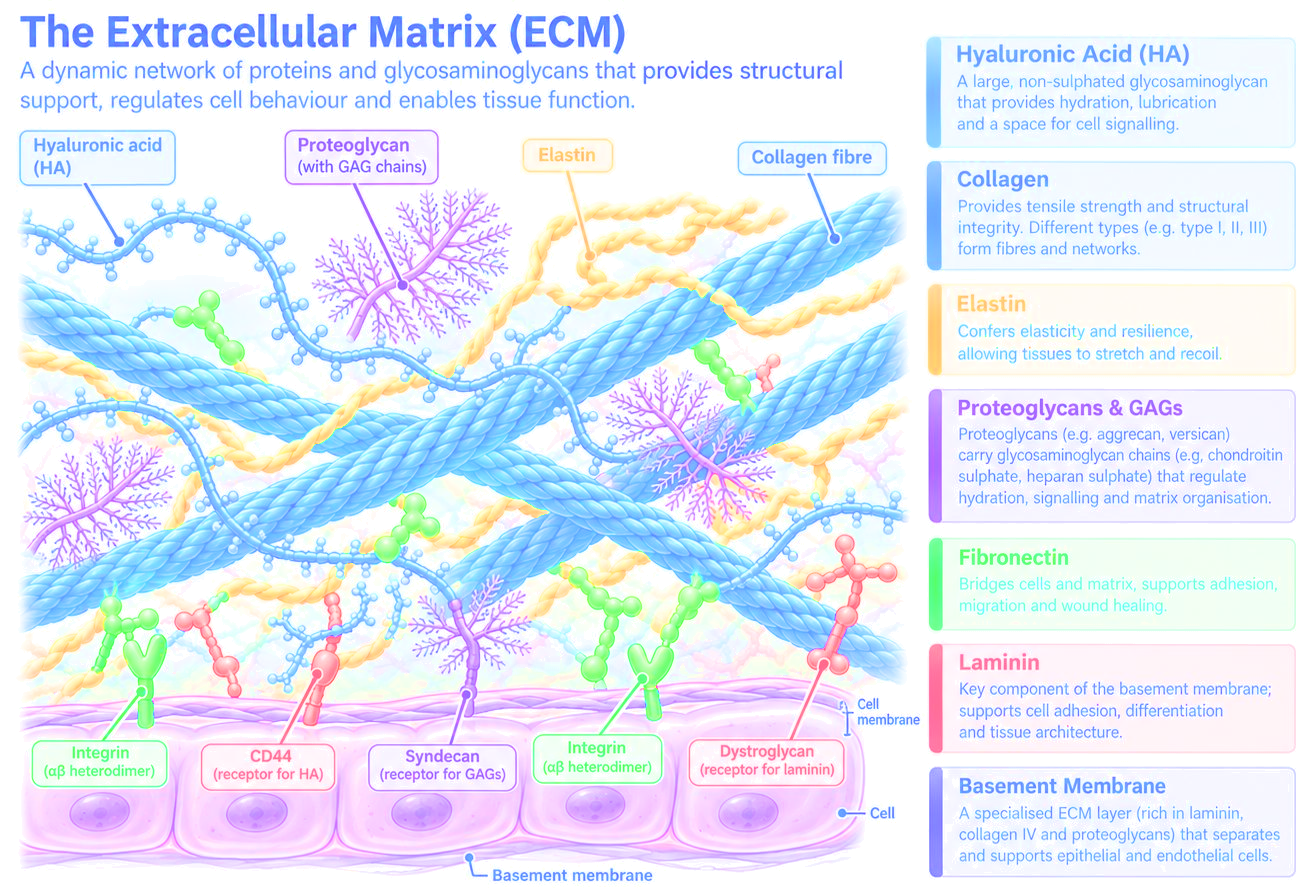
The ECM forms a complex, dynamic network or scaffold that maintains tissue structure, shape, stiffness, elasticity etc. It also enables communication and shape the behaviour between cells and the matrix.
It play a critical role in development, repair and disease biology (e.g. cancer, ageing, fibrosis etc).
ECM = The Matrix = Tumour Environment
Change the matrix,
change the message,
change the outcome.
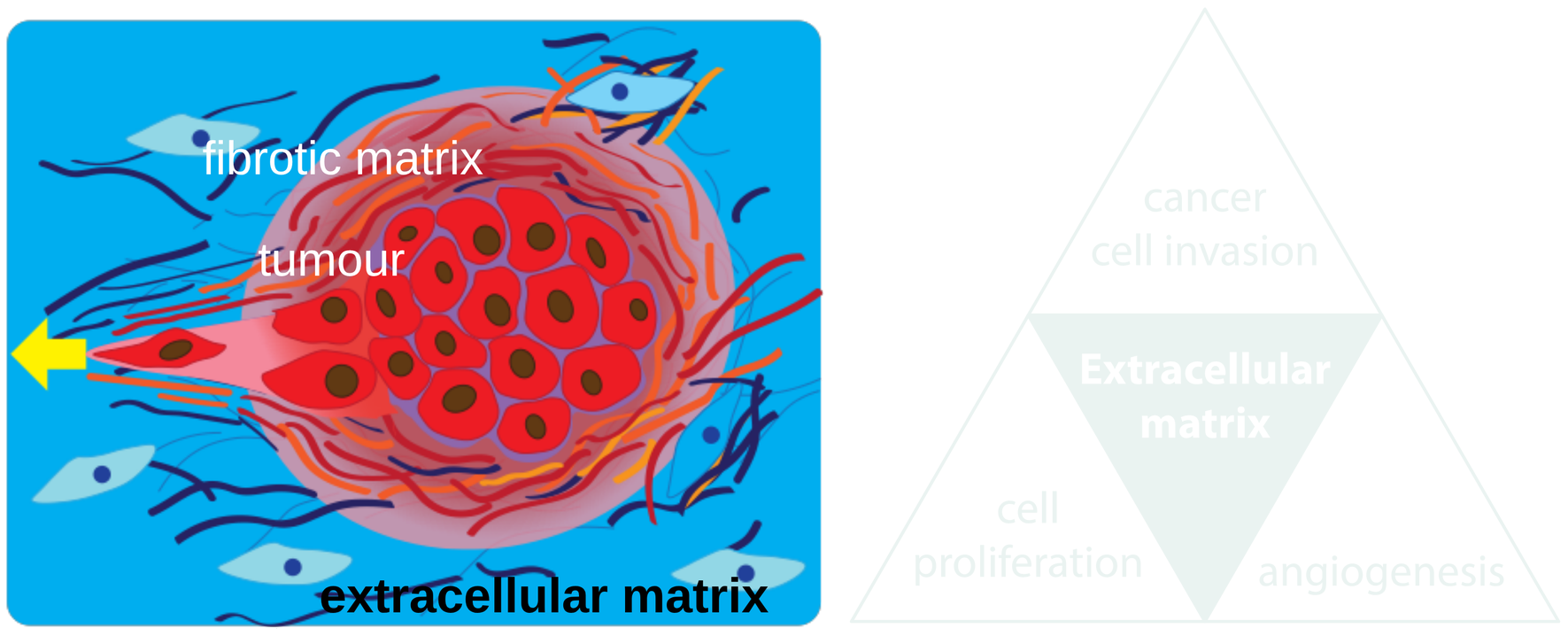
The ECM is one of the first things to change in cancer, and it changes dramatically. Fibrous proteins accumulate around most solid tumours.
That altered ECM means cancer cells and all cells in the vicinity of the tumour are receiving altered instructions, and those altered instructions drive increasingly aggressive cancer cell behaviour.
Successful communication depends not simply on which extracellular matrix molecules are present, but on how those molecules move.
There is now increasing evidence that these pathological extracellular matrix changes contribute to tumour progression, promoting cancer cell proliferation, angiogenesis and cancer cell invasion.
Fundamentally, cancer is not simply a disease of abnormal cells; it is also a disease of an abnormal extracellular matrix. And if cells make decisions based on instructions from the extracellular matrix, then drugs that change those instructions allow us to change cell behaviour.
Change the matrix, change the message, change the outcome.