Role of hyaluronic
acid in glioblastoma (GBM)
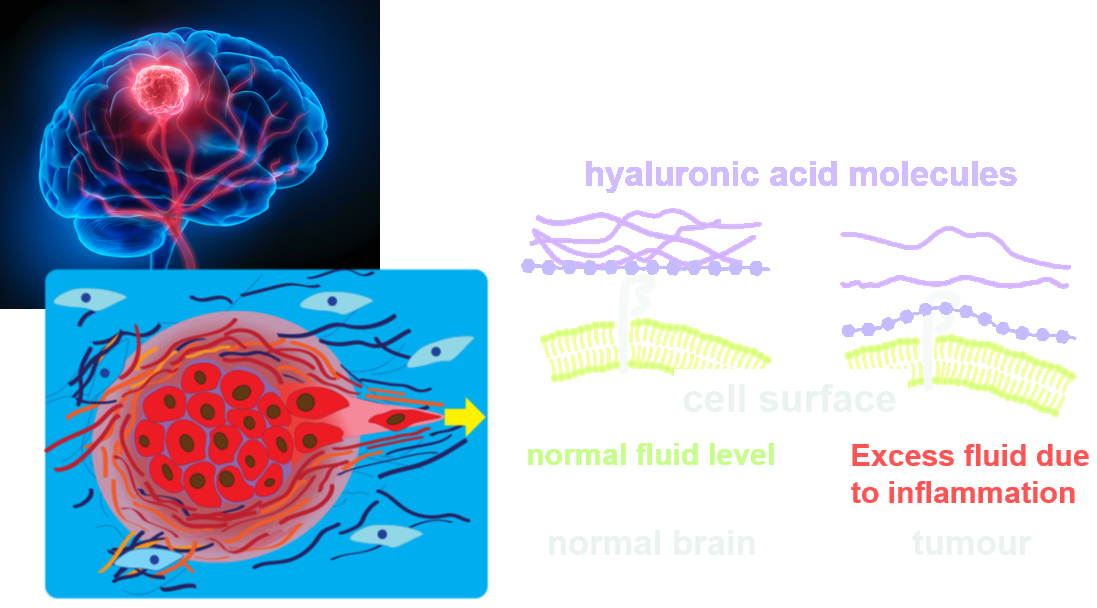
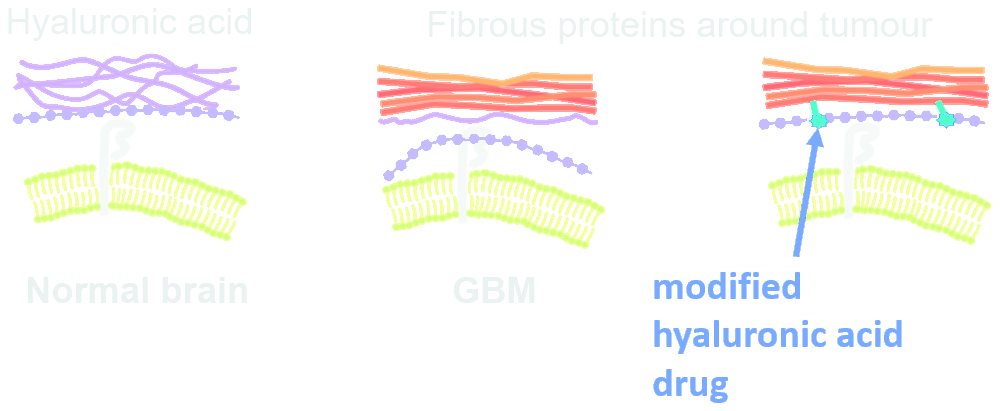
In GBM, the ECM around the tumour changes fundamentally. The matrix becomes highly fibrous around the tumour (contrast to normal, healthy brain) and the hyaluronic acid (HA) surrounding the tumour contributes to tumour progression.
In normal brain, HA molecules are tightly packed together and relatively inflexible – and in that situation there is no signal to any cells; the inflexible HA molecules effectively communicate to all cells in the brain that there is nothing they need to do.
But in GBM, there is a lot of fluid from inflammation or from post-surgery oedema, and that fluid pushes the HA molecules in the brain further apart than they would normally be and gives them space to twist and flex. This HA flexibility in the tumour environment means they link up highly effectively with cancer cell receptors (CD44) to signal to the cancer cells that the matrix is weak - because it is diluted – and the cancer cell response to that HA-receptor signal is to invade – INVASION ON.
Our intervention – reprogramming GBM cells
by drugging the tumour environment
So our findings on how flexible HA molecules cause cancer cells to invade, drove us to work on an entirely new kind of treatment that reverses the devastating effect of flexible hyaluronic acid molecules around brain tumours.
If flexible HA molecules trigger cancer cell invasion, then to stop invasion, we would need to immobilise the HA molecules to make them inflexible again – to “re-normalise the brain setting”. This would stop the cancer cells receiving the signal to move, and so they should either never start invading or if they are already invading, they should stop – INVASION OFF.
Our lead compound – oxHA – is a chemically modified form of HA acid that becomes immobilised within the fibrotic tumour extracellular matrix by re-normalising the brain-setting.
With this approach, we don't need to deliver the drug specifically to every cancer cell. Instead, we treat the tumour environment itself.
Because the modified HA becomes immobilised within the fibrotic extracellular matrix, the tumour microenvironment itself effectively localises the therapeutic where it is needed.
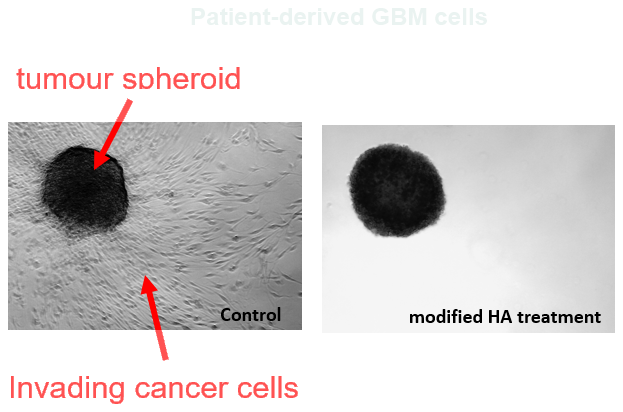
oxHA.
oxHA is an oxidised, crosslinkable polymer that mimics hyaluronic acid. It is designed to re-set the matrix to its normal-brain state, holding it still so that the instruction to invade is switched off and cancer cells stay dormant.
Preclinical work supports taking oxHA into the next stage of studies, with the size of its effect, its safety profile and its delivery route as the milestones ahead.
The hardest place
to start.
Brain matrix is unlike the matrix of breast or pancreatic tumours. It is rich in hyaluronan and proteoglycans, comparatively lower in fibrillar collagen, and organised quite differently, which makes glioblastoma both a distinctive target and a rigorous test of the idea.
It is also where a new approach is most needed: the standard of care has changed little in two decades, and the disease returns at the margin of surgery. If changing the matrix helps, glioblastoma is where that should show first.